

Accountability Ladder
- Difficult Conversations
- Feedback
- Influencing
- Insights
- Listening
Accountability Ladder?
A simple shared language for getting things done.
The Accountability Ladder gives your team a common way to talk about ownership on any task. It helps people notice when they have slipped below the line and encourages a shift above the line where real progress happens.
In this short video, we walk through the Accountability Ladder and how teams use it day to day to move conversations forward.
What is the Accountability Ladder?
A practical model that names two sets of behaviours:
- Below the line — behaviours that signal a lack of accountability.
- Above the line — behaviours that show ownership and momentum.
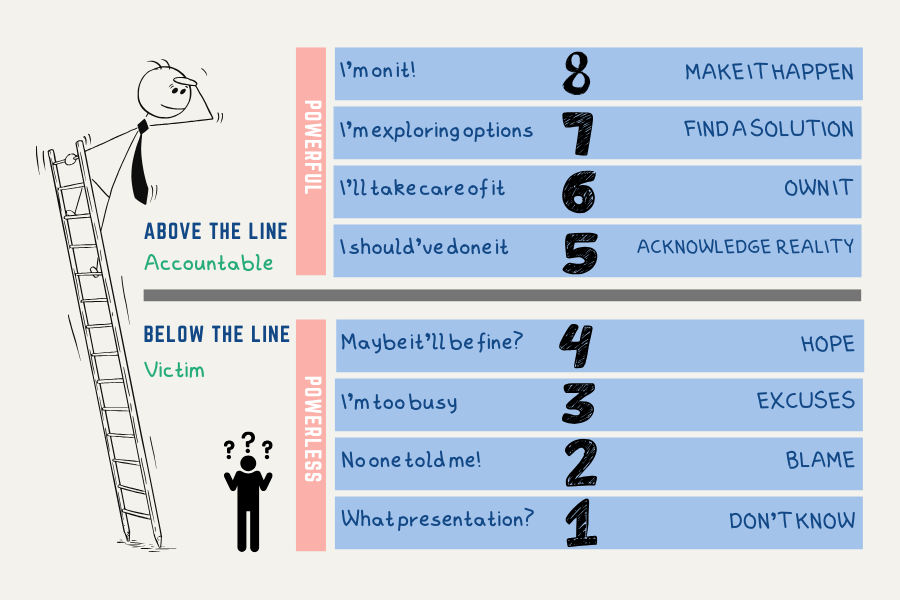
When everyone knows the language, a gentle “Where are we on the ladder right now?” can reset the conversation in seconds.
Below the line behaviours
These often sound familiar in busy teams. They are human, but unhelpful.
- “I don’t know.”
- “You never told me I had to do that.”
- Blame — “Sarah in Finance never sent me the info.”
- Excuses — “It’s been manic this week. I’ll get to it.”
- Hoping — “Fingers crossed it will go away.”
Impact: delays, frustration, and plans without execution.
Above the line behaviours
This is where ownership lives and work moves.
- Acknowledge reality “I slipped up and haven’t got the data to you.”
- Take responsibility “This is my job to fix.”
- Find solutions “I’ll go and see Sarah in Finance and sort it.”
Impact: clarity, pace, and promises that turn into action.
Why it works for teams
- Shared language reduces friction and makes feedback easier.
- Quick self-check helps people notice and shift their own stance.
- Focus on execution — ideas and strategies only land when someone owns the follow-through.
Use it in practice
Micro-moment reset
Ask: “Where are we on the ladder right now?”
Follow with: “What would move us one rung up?”
Daily stand-ups
Invite one “ladder check” per update: state the task, name the rung, say the next action.
One-to-ones
Explore what pulled someone below the line and agree one concrete step above the line.
Meetings
Capture actions in “above the line” language: owner, first step, by when.
Prompts you can use:
“What part of this is mine to own?”
“What is the first useful step?”
“Who needs to know and by when?”
“If I were fully accountable, what would I do next?”
Conversation starters for managers
“I can hear some hoping and blaming. What would ownership sound like here?”
“What help do you need to move one rung up today?”
“Let’s turn that reason into an action we control.”
Common pitfalls to avoid
Shame or blame. The ladder is a mirror, not a weapon.
All-or-nothing thinking. One rung up is progress.
Vague actions. Name the next observable step with a time.
FAQ’s
Is this about being tough on people?
No. It is about being clear on what we can control and taking the next useful step. It reduces stress and improves momentum.
What if the blocker is real, like missing data from another team?
Name it, then choose an above-the-line response: escalate, agree a workaround, or set a new deadline. Ownership sits with the next action.
How does this link to Insights Discovery®?
Every colour energy gives and receives accountability differently. When people flex their style, the message lands better and relationships strengthen. We weave simple style shifts into the practice.
Can we use the ladder without a workshop?
Yes. Start with the video, print the poster, and try the micro-moment reset this week. A workshop accelerates adoption and makes it part of everyday conversation.