

Insights Discovery® Keynotes for Conferences
Energise your audience. Spark real conversation. Make it stick.
A keynote that goes beyond the day
If you are planning a conference, leadership event or company wide gathering, you want a keynote that does more than entertain.
You want people to leave thinking differently about how they work together.
As an Insights Discovery® keynote speaker for conferences, Juicing The Lemon delivers engaging, thought provoking sessions that help large audiences understand themselves, understand others and work together more effectively.
Our keynotes combine humour, real world stories and the powerful simplicity of the Insights Discovery® colour model to create moments that people remember long after the event.
Most importantly, audiences leave with practical ideas they can apply the very next day.
What makes our keynotes different

More than inspiration
Many keynotes inspire people in the moment. Few give them something practical they can use afterwards. Our keynotes are designed to do both, helping people think differently about how they work together and what that looks like day to day.

A simple, shared language
Using the globally recognised Insights Discovery® model, we help audiences understand communication differences, where misunderstandings arise and what great collaboration looks like.
It creates a shared language everyone can relate to.

Engaging and relatable
Our keynotes are highly engaging and interactive, even with large audiences. People recognise themselves in the colour energies, laugh at familiar situations and reflect on how their style impacts others.

Practical and lasting
Audiences leave with simple, practical ideas they can use straight away. More importantly, the keynote creates a foundation that continues beyond the event, supporting better conversations, collaboration and future development.
Insights Discovery® Keynote Speaker FAQs
From keynote to conversation
A keynote can be engaging, funny and memorable. But for us, that isn’t enough.
When we bring Insights Discovery® to a conference, company event or large audience, we want people to recognise themselves, understand something about the people around them and leave with an idea they can actually use.
We don’t try to squeeze a three-hour Insights workshop into a 60-minute keynote. We decide what we want people to notice, understand and do differently – and build the experience around that.
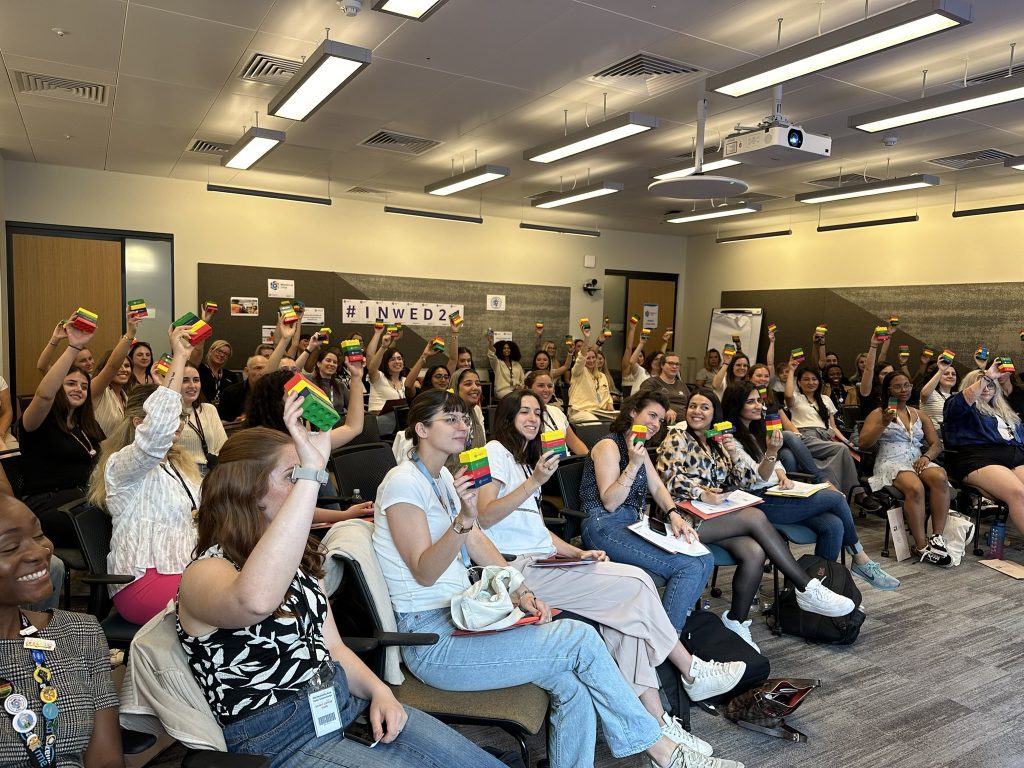
That might mean stories, live demonstrations, actors bringing familiar workplace situations to life, quick activities to reveal the colour preferences in the room, or hundreds of people turning to someone beside them to have a conversation.
Our approach is:
Make it recognisable → Get people involved → Help them understand → Make it personal → Practise the 5% Flex → Give them something to take away.
Because a large audience doesn’t have to mean a passive audience.
Can Insights Discovery really work as a keynote for a large audience?
Yes. The format needs to change, but the principles don’t.
We’ve delivered interactive Insights Discovery sessions for large audiences including around 100 people at Amazon, 120 in the NHS, 90 at Tangerine Communications and 130 at Jupiter Asset Management.
The challenge with a large audience is that it can easily become passive. One person talks. Everybody else listens.
We deliberately design against that.
We use short activities, stories, live demonstrations, audience participation and conversations in pairs so that everyone has opportunities to think and participate – without needing 100 people to report back to the room.
At Jupiter Asset Management, for example, people completed a quick exercise to explore where they might sit in terms of behavioural preference and then discussed what they had noticed with the person beside them. Later, they identified someone they wanted to work with more effectively and considered the 5% Flex they could make in their own behaviour.
That’s the difference between simply hearing about Insights and beginning to apply it.
A large audience doesn’t have to mean a passive audience.
What can you realistically achieve with Insights Discovery in a 60-minute keynote?
Less than we could achieve in a three-hour workshop – and that’s important to acknowledge.
A keynote isn’t the place to try to teach everything there is to know about Insights Discovery.
Instead, we decide what matters most.
We might help people understand the four colour energies, recognise some of their own behavioural preferences, appreciate why other people may approach work differently and identify one small change they could make to communicate or collaborate more effectively.
At JTL, we call that the 5% Flex.
It isn’t about becoming somebody different. It’s about making a small, conscious adjustment in your behaviour because you’ve recognised that the person or situation in front of you may need something different from you.
A good keynote should leave people wanting to understand more – but also give them something useful they can do straight away.
The aim isn’t to teach everything about Insights. It’s to give people enough understanding to notice something and do something differently.
How do you make an Insights Discovery keynote interactive when there are 100+ people in the room?
You design activities that allow lots of people to participate at the same time.
That sounds obvious, but it’s very different from running a workshop for 12 people.
We regularly get people working in pairs, reflecting individually, responding to questions, showing preferences in the room and discussing what they are noticing with the person beside them.
We might ask people to consider:
What behaviour do I recognise in myself?
What might it be like to be on the other side of me?
Which preferences are showing up in this room?
Who do I find particularly easy – or harder – to work with?
What’s one 5% Flex I could make?
The facilitator can then draw out a handful of observations from the wider audience.
This creates a useful rhythm:
Think → Talk → Notice → Share → Apply.
It means everyone can be doing something, even if only a few people ever speak into the microphone.
That’s one of the biggest lessons we’ve learnt from delivering Insights with large groups: interaction at scale doesn’t mean everyone has to talk to the facilitator.
How do you bring Insights Discovery to life at a conference rather than just talking about four colours?
We want people to experience the differences, not simply be told about them.
One of the ways we do that is through actors.
At both Tangerine Communications and Jupiter Asset Management, we’ve used professional actors alongside the facilitator to bring familiar workplace interactions to life.
Beforehand, we talk to the organisation and understand the kinds of conversations, situations and relationships people recognise from their working lives. We can then build those into scenarios.
At Jupiter, for example, our actor played the same HR character four different ways, delivering essentially the same message using four very different communication styles.
Before we’d spent lots of time explaining the model, people could already feel the differences.
Some versions felt comfortable. Others didn’t.
People recognised themselves. They recognised colleagues. And they laughed.
That’s powerful because the learning begins with experience rather than theory.
People laugh because they recognise it. Then we help them understand what’s happening underneath it.
How do you tailor an Insights keynote to our organisation and audience?
We don’t believe the same keynote should simply be lifted from one organisation and delivered unchanged to another.
Before the event, we’ll talk to you about your audience, your organisation and what you want people to take away.
We want to understand questions such as:
Who will be in the room?
Why are they together?
What are the conversations they typically have?
Where do misunderstandings or frustrations occur?
What would you love people to be talking about afterwards?
Where appropriate, we’ll use those conversations to create examples, stories and scenarios that feel familiar to your people.
This becomes particularly powerful when we’re working with actors because we can recreate recognisable situations without identifying or embarrassing individuals.
When people see something on stage and think “We do that!”, we’ve got their attention.
We can then use Insights to explore what might be happening and what people could do differently.
How do you stop Insights colour energies becoming stereotypes in a large conference session?
Very deliberately.
A short session creates a particular risk because it’s tempting to simplify Insights into:
“I’m Red.”
“She’s Green.”
“He’s definitely Yellow.”
That’s memorable, but it isn’t how we want people to use the model.
Everyone has access to all four colour energies. People also flex their behaviour depending on the situation, relationship and context.
We saw a lovely example of this during our Jupiter session when one participant reflected that he behaved quite differently with his team, with clients and at senior-management level.
That’s normal.
Insights gives us a language for exploring those differences. It shouldn’t become a set of boxes that restrict people.
We encourage people to develop a working hypothesis about what another person might need rather than deciding that they have worked somebody out.
Our rule of thumb is:
Colour should make us more curious about each other, not more certain about each other.
Can an Insights keynote help people communicate and influence more effectively?
Yes – and this is where we want to move beyond simply knowing your own preferences.
Self-awareness is the starting point.
The more interesting question is:
What does the person in front of me need from me?
Someone may need you to get to the point more quickly. Someone else may need more detail. Another person may need time to think. Someone else might want the opportunity to talk their thinking through.
The answer isn’t to learn four scripts.
It’s to notice what’s happening and flex intelligently.
During our Jupiter session, participants chose an actual person they wanted to work with more effectively and considered what that person’s preferences might be and what small change they could make themselves.
One participant recognised that his naturally fast pace could mean he needed to give some colleagues more time. Another considered focusing more strongly on outcomes when communicating with colleagues who might value that.
That’s the 5% Flex in practice.
Use your own style confidently. Then flex it intentionally.
Is an Insights Discovery keynote serious learning or just a fun conference session?
We think it should be both.
Laughter and energy aren’t the enemy of learning.
Used well, they help people recognise behaviours that can otherwise feel theoretical or uncomfortable to discuss.
Stories help too.
In one of our sessions, we use the simple example of a neighbour who trips over some loose carpet.
One person might immediately want to make sure they’re OK, sit them down and make a cup of tea.
Someone else is looking at the carpet thinking:
“We need to fix that.”
Of course, sensible people ultimately do both.
The interesting question is: where did your attention go first?
A simple story makes an abstract behavioural preference instantly recognisable.
That’s why our keynote sessions often have plenty of laughter and energy in the room. But there’s serious thinking underneath it.
We’re interested in the moment when someone laughs and then thinks:
“Actually… I do that.”
That’s where the learning starts.
What do people take away from an Insights Discovery keynote?
We want people to leave with more than four colour names.
Depending on the purpose and length of the session, that might include a better understanding of their own preferences, greater appreciation of colleagues who work differently, a shared language they can use afterwards and a practical idea for adapting their behaviour.
We also want people thinking about their shadow.
What’s it like to be on the other side of you?
The qualities that make you brilliant can sometimes become less helpful when you’re under pressure or when you overuse them. Understanding that impact is an important part of self-awareness.
So towards the end of a keynote, we’ll often bring people back to a few simple questions:
What makes me tick?
What’s the shadow I cast?
What do other people bring that I may naturally value less?
What’s my 5% Flex?
A keynote can’t create lasting behaviour change by itself.
But it can create recognition, give people a shared language and provide a practical starting point for doing something differently.
When is an Insights Discovery keynote not the right solution?
Not every organisational challenge needs a keynote.
If you need a team to work through significant conflict, address a specific performance issue, rebuild trust or make sustained changes to how they work together, a large conference session is unlikely to be enough.
Similarly, if you want people to explore their individual Insights Discovery Personal Profiles in depth, we would normally recommend a smaller workshop where there is more time for reflection, discussion and application.
A keynote works particularly well when you want to create energy around an event or theme; introduce Insights Discovery to a larger population; give people a memorable shared language; encourage better conversations across an organisation; or spark curiosity that can be developed through further workshops or team activity.
Sometimes the keynote is the whole intervention.
Sometimes it’s the beginning of something bigger.
We’ll talk to you about what you’re trying to achieve before recommending the format.
Because the starting point should be the problem you’re trying to solve, not the keynote you’re trying to buy.