

Sunshine Yellow Energy in Insights Discovery®
What It Means at Work
Who We Work With


Sunshine Yellow is one of the four colour energies in Insights Discovery®, alongside Fiery Red, Earth Green and Cool Blue.
Someone with a strong preference for Sunshine Yellow energy may bring enthusiasm, optimism and a real gift for connecting people and ideas. They often enjoy thinking out loud and developing ideas through conversation with others.
At Juicing The Lemon, we think of it as the energy that can lift a meeting, spot what could be possible and bring people along for the ride.

What Sunshine Yellow energy looks like on a good day
On a good day, someone leading with Sunshine Yellow energy can be enthusiastic, persuasive, sociable, expressive and dynamic.
They may be the colleague who fills the silence on a call when nobody quite knows what to say, or who brings fresh energy to a conversation that has gone flat. Many people with this preference enjoy a group brainstorm, where ideas spark off each other and the conversation creates momentum.
Sunshine Yellow energy also tends to look ahead. It is often future-focused and optimistic, quick to spot possibilities and reframe a challenge as an opportunity.
At its best, that optimism stays grounded. Someone using Sunshine Yellow energy with emotional intelligence might say, “I know this is tough right now, and there is light at the end of the tunnel” — recognising where people are today while helping them see where they could get to.
Connection is another strength.

Angela Mitchell, our founder,
often describes Sunshine Yellow energy as having a one-to-many strength, in contrast to the one-to-one strength often associated with Earth Green energy.
People drawing strongly on Sunshine Yellow energy often build wide networks, know lots of people and enjoy connecting across teams, functions or industries. They may flourish in larger groups, where they can bounce ideas around, make introductions and bring people together.
Earth Green energy often shows up differently: relationships may be fewer but deeper, with a preference for one-to-one conversations or smaller groups where there is more time to listen, understand and build trust.
Neither is better; they are simply different ways of connecting with people.
In our workshops, we like to bring the colour energies to life through familiar examples.
The Sunshine Yellow email is often the one that begins “Happy Friday!”. It may be the person who starts chatting about the weekend while everyone is waiting for a video call to begin, or the friend at the pub who becomes so engrossed in conversation at the bar that they forget to order the drinks. Pasted markdown
These examples are deliberately light-hearted. The point is not that everyone with Sunshine Yellow energy behaves in the same way, but that familiar moments can help people recognise a preference and start a useful conversation.
Where Sunshine Yellow energy comes from
Insights Discovery® is a psychometric model informed by Carl Jung’s theory of psychological types, first set out in Psychological Types in 1921.
The four colour energies draw on preferences including Extraversion and Introversion, which relate to how people tend to engage with the world, and Thinking and Feeling, which relate to how people tend to make judgements and decisions.
Sunshine Yellow energy reflects a preference associated with Extraversion and Feeling. In practice, that can show up as an outward, people-focused way of engaging, with an interest in possibilities, relationships and how ideas might land with others.
Extraversion here should not be confused with confidence, being the loudest person in the room or always wanting attention.
As with every colour energy, Sunshine Yellow is a preference rather than a fixed type. Everyone uses all four colour energies, and context, experience, role and emotional intelligence all influence how those preferences show up.
You can read more about the evidence behind the model on our Validity and Reliability page.
Sunshine Yellow energy under pressure
Every colour energy has a good day and a bad day, and Sunshine Yellow is no exception.
The question we keep coming back to in our workshops is not whether someone has Sunshine Yellow energy, but how well they are using it.
Under pressure, the same enthusiasm that energises a team can begin to feel scattered: lots of ideas, plenty of excitement, but not always enough clarity about what happens next.
On a bad day, Sunshine Yellow energy may come across as excitable, frantic or hasty.
Someone drawing heavily on it may fill so much of the conversation that colleagues who prefer time to reflect struggle to find a way in. They may focus so strongly on the positive future that they miss how difficult things feel for other people right now.
Stories can grow in the telling too, so a small moment on the morning commute may become quite the tale by the time it reaches the team.
A few blind spots come up regularly in our work.
Detail and deadlines can drift when the next exciting idea appears. When someone leading with Sunshine Yellow energy delegates, they may have a brilliant, energising conversation and still leave the outcome, standard or deadline unclear.
During change, they may embrace the new idea enthusiastically at the beginning but find the slower work of implementation less energising.
Naming a bad-day behaviour is not the same as excusing it. A shared language simply makes the pattern easier to spot and talk about, so something can change.
None of this is fixed.
For some people, Sunshine Yellow is their lead energy. For others, it may be more of a teaspoon than a tablespoon. Their other colour energies, role, experience, values and emotional intelligence all shape how it appears.

A 5% flex we often see in workshops
In our workshops, we often see people with a strong Sunshine Yellow preference recognise that they are usually first into a conversation. They think out loud, answer quickly and can fill a silence before other people have had time to form their view.
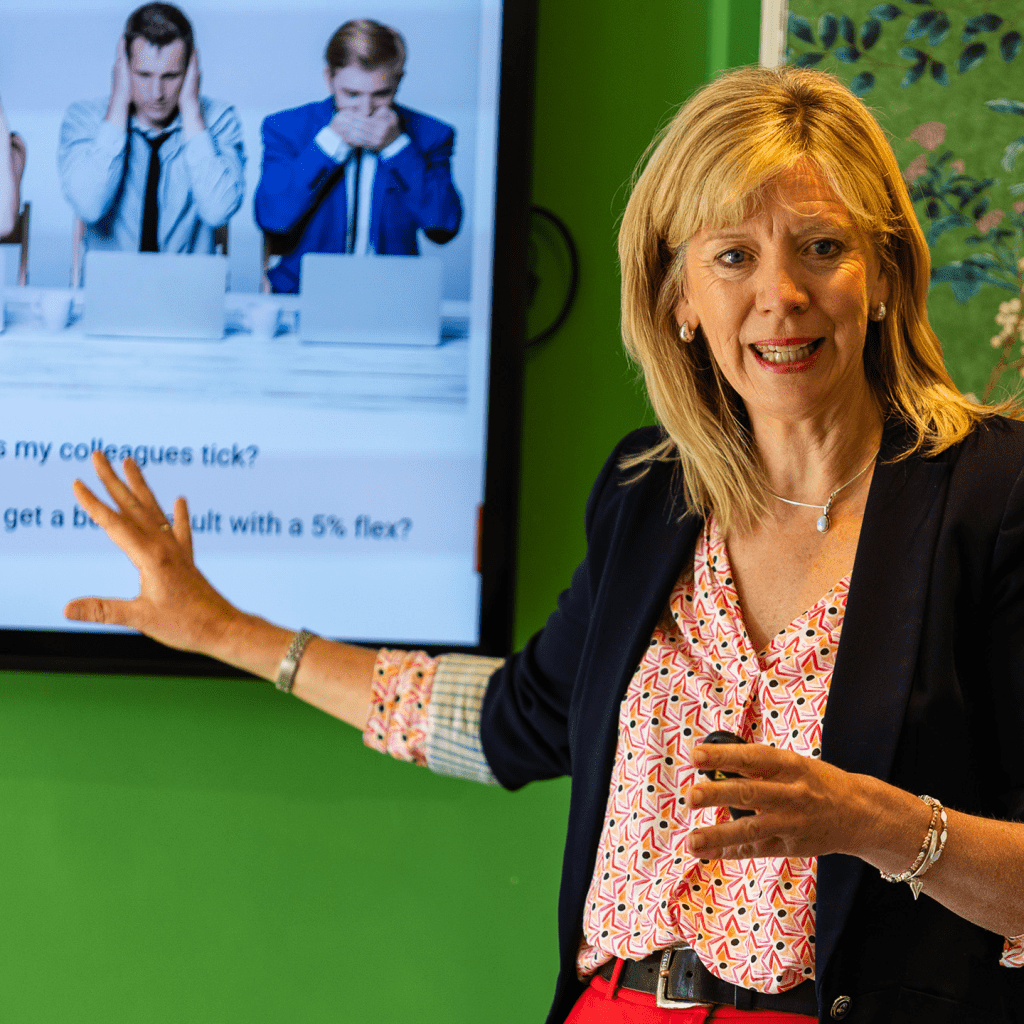
One of the 5% flexes we encourage is simple: ask the question, hold back, invite a couple of other people to speak first, and then add your own view.
It can make a noticeable difference. The Sunshine Yellow energy is still there, but it is being used with more awareness. Instead of creating energy through airtime, the person creates space for more voices to be heard.
That pattern is consistent with a common observation about highly verbal Yellow-style behaviour: the strength of readily contributing can sometimes be experienced by others as dominating the conversation.
How to work well with someone who leads with Sunshine Yellow energy
At the heart of our approach is the 5% flex: a small, deliberate adjustment to your own style that helps another person stay at their best.
With someone drawing strongly on Sunshine Yellow energy, that flex might look like this.
Be friendly, sociable and stimulating
Allow some space for relationship and conversation at the beginning. Recognise original thinking and give them room to talk an idea through.
Angela’s slightly tongue-in-cheek rule of thumb is to allow a little extra time for a conversation with someone who enjoys thinking out loud. In our experience, once people have had the chance to explore their thinking verbally, they are often more ready to hear somebody else’s view.
Lead with the headline, not the spreadsheet
Start with the big picture and why it matters, then bring in the detail that is genuinely needed.
Long runs of facts and figures may lose someone whose attention naturally goes first to possibilities and ideas.
At the same time, keep the essentials visible: the agreed outcome, what good looks like, who owns what and the deadline.
Enthusiasm and clarity work well together.
Recognise contribution, but challenge well
Many people drawing strongly on Sunshine Yellow energy value visible recognition and connection.
That does not mean avoiding difficult feedback or challenge. It means thinking about how and where you deliver it.
A private, direct conversation may land better than challenging somebody’s idea or story publicly, particularly if the aim is to help them reflect rather than defend themselves.

Give ideas somewhere to land
Sunshine Yellow energy can generate possibilities quickly. The useful flex is to help turn that energy into something concrete.
Before a conversation ends, agree what happens next, who owns it and when it will be done.
That preserves the energy without relying on enthusiasm alone to carry the work forward.
Sunshine Yellow and Cool Blue: a pairing we see regularly
Another pattern we see regularly in workshops is the tension between Sunshine Yellow and Cool Blue energy.
The Sunshine Yellow colleague may want to get into the room, talk the idea through and see where the conversation goes. The Cool Blue colleague may want the question, the context and some time to think before the meeting starts.
Each can easily see the other as difficult: one too unstructured, the other too cautious.
A useful 5% flex is for both sides to move slightly.
The Sunshine Yellow colleague sends a short headline or key question in advance, so the Cool Blue colleague has time to prepare. In return, the Cool Blue colleague experiments with sharing an emerging thought earlier, rather than waiting until every detail feels complete.
Neither person has to become more like the other. They simply make a small adjustment so the other person has a better chance of working at their best.
Treat all of this as a useful starting hypothesis rather than a label.
Try the flex, notice how the person responds and adjust.
The person matters more than the colour energy.
Frequently Asked Questions
What are the strengths and possible blind spots of someone with strong Sunshine Yellow energy?
Someone with a strong Sunshine Yellow preference may bring enthusiasm, optimism, persuasiveness, creativity and a real talent for connecting people and ideas.
The same strengths can become less helpful under pressure. Enthusiasm can become scattered, optimism can overlook how difficult things feel for others, and thinking out loud can take up more airtime than intended.
At Juicing the Lemon, we tend to focus less on whether someone has strong Sunshine Yellow energy and more on how well they use it.
The key question is whether the preference is being used with enough self-awareness and emotional intelligence for the situation.
How do you work effectively with someone who has strong Sunshine Yellow energy?
Start with warmth and the big picture.
Someone drawing strongly on Sunshine Yellow energy may appreciate a lively conversation, room to think out loud and a clear sense of why something matters.
Recognise their ideas, keep the pace moving and avoid burying the main point under unnecessary detail.
At the same time, make sure the essentials are clear before you finish: the outcome, what good looks like, who owns what and the deadline.
In our workshops, we describe this as a 5% flex: a small, deliberate adjustment in style that helps the other person stay at their best.
Does Sunshine Yellow energy mean someone is extroverted and confident?
Not necessarily.
Sunshine Yellow energy is associated with Extraversion in the Insights Discovery model, but that should not be confused with confidence, being the loudest person in the room or always wanting attention.
Someone may enjoy thinking aloud, connecting with others and generating energy through conversation while still feeling nervous in unfamiliar situations or lacking confidence in a particular area.
Equally, someone can be highly confident without having a strong Sunshine Yellow preference.
That is why we encourage people to treat colour energy as a clue to preference rather than a verdict about personality.
Does strong Sunshine Yellow energy mean someone is disorganised or bad with detail?
No.
A Sunshine Yellow preference does not tell us whether someone is capable of planning, working with detail or meeting deadlines.
What it may tell us is where their attention naturally goes first. Someone drawing strongly on Sunshine Yellow energy may be energised by ideas, possibilities and interaction, while detailed follow-through may require more deliberate attention.
Their experience, role, habits and other colour-energy preferences matter too.
Someone with strong Sunshine Yellow and Cool Blue energy, for example, may combine visible enthusiasm and creativity with considerable structure and attention to detail.
Can someone with strong Sunshine Yellow energy be a good leader?
Absolutely.
There is no single colour energy associated with good leadership.
Sunshine Yellow energy can bring optimism, visible energy, connection, creativity and the ability to bring people with an idea. Those qualities can be particularly useful when a team needs momentum, possibility or renewed confidence.
The potential stretch is making sure enthusiasm does not crowd out other voices, and that optimism is balanced with enough clarity, follow-through and attention to how people are really feeling.
As with every colour energy, the question is not whether someone has a particular preference, but how effectively they use it and how willing they are to flex.
How does Sunshine Yellow energy work alongside the other colour energies?
Sunshine Yellow energy never operates in isolation. Everyone uses all four colour energies, and the combination matters.
Someone leading with Sunshine Yellow and drawing strongly on Fiery Red may bring pace, confidence and visible enthusiasm.
With Earth Green next, that same energy may be accompanied by a stronger focus on relationships and inclusion.
With Cool Blue more available, creativity and optimism may be balanced by greater structure and attention to detail.
In our workshops, this is often where people realise why two colleagues who both appear “very Sunshine Yellow” can still feel quite different to work with.
The colour energies are most useful when they help us explore those differences rather than reduce people to a single label.
How might someone with strong Sunshine Yellow energy respond to change?
In our experience, someone drawing strongly on Sunshine Yellow energy may initially respond to change with energy, ideas and optimism, particularly if they can see possibility in what is coming.
They may want to talk the change through with other people and contribute ideas about how it could work.
The stretch can come later. If the reality becomes more restrictive, detailed or repetitive than expected, enthusiasm may dip.
Involving them early, giving them a voice and keeping a clear link to the bigger picture can help.
As always, treat this as a starting hypothesis rather than a prediction.
The person matters more than the colour energy.
Should Sunshine Yellow energy be used to decide who gets hired or promoted?
No.
Insights Discovery describes behavioural preferences. It does not assess competence, potential or suitability for a particular role.
A strong Sunshine Yellow preference does not make someone more suited to sales, leadership or creative work, just as it does not make them less suited to analytical or technical roles.
Insights Discovery should be used to support self-awareness, communication and team effectiveness — not to make hiring or promotion decisions.